2012/08/03

Romeo and Juliet


Did you know that the story from which William Shakespeare drew his inspiration for the writing of the tragedy "Romeo and Juliet" is the autobiographical novel written by Luigi Da Porto? In fact, the "real" Romeo and Juliet are Luigi Da Porto and  Lucina Savorgnan.
Luigi Da Porto and Lucina Savorgnan meet at a party during the carnival of Udine (Friuli Venezia Giulia) in 1511 and fall in love. Luigi and Lucina are distant cousins​​ and live a love made impossible by the rivalries of their families, at the time of a bloody uprising in Friuli.
Luigi Da Porto (1485-1529) was born in Vicenza in a noble and powerful family, and lived between military occupations and leisure studies.  Captain of a cavalry company in the service of Venice, he was severely wounded in battle on June 20, 1511 and was forced to retire to his villa in Montorso Vicentino. Here, in the poignant reminder of the promise of love made to Lucina, Da Porto composes the "Historia novellamente ritrovata di due nobili amanti”.
In 1539 a slightly different version of the story was published with the title  “La Giulietta”.
About 70 years later, William Shakespeare read the English translation and wrote his most beautiful tragedy.
For reasons of political prudence and safeguard of the identity of the real protagonists, Luigi Da Porto sets his story  at the time of Bartolomeo della Scala (1301 - 1304), in Verona.

Cecil Clough, an expert  of Renaissance literature, has proved, after extensive research, that the characters of Da Porto’s story have no view of history, nor really lived in the fourteenth century Verona. He asserts that it is  Udine in the Friuli Venezia Giulia region and not Verona, the birthplace of this impossible love made famous by Shakespeare. 


Villa "Da Porto - Barbaran" in Montorso  

Sapevate che la storia da cui William Shakespeare trasse la sua ispirazione per la stesura della tragedia “Giulietta e Romeo” è la novella autobiografica scritta da Luigi Da Porto? Infatti, i "veri" Giulietta e Romeo sono Lucina Savorgnan e Luigi Da Porto. 
Luigi Da Porto e Lucina Savorgnan s’incontrano ad una festa durante il carnevale di Udine nel 1511 e s’innamorano perdutamente. Cugini alla lontana, vivono un amore reso impossibile dalla rivalità delle rispettive famiglie, al tempo di una sanguinosa rivolta popolare in Friuli.
Luigi Da Porto (1485-1529) nacque a Vicenza in una nobile e potente famiglia e visse tra occupazioni militari  e ozi umanistici. Comandante di una compagnia di cavalleggeri al servizio di Venezia, venne ferito gravemente in battaglia il 20 giugno 1511  e fu costretto a ritirarsi nella sua villa di Montorso Vicentino. Qui, nel ricordo struggente della promessa d’amore stretta in segreto con Lucina, compone la “Historia novellamente ritrovata di due nobili amanti”. Nel 1539 la storia fu riproposta, leggermente diversa, con il titolo “La Giulietta”.
Circa 70 anni dopo, William Shakespeare la lesse in traduzione inglese e scrisse la sua tragedia più bella, oggi simbolo universale dell’amore.
Per ragioni di prudenza politica e di salvaguardia dell’identità reale dei protagonisti, Luigi Da Porto trasporta lo svolgimento della novella a Verona, ai tempi di Bartolomeo della Scala (1301-1304).

Cecil Clough, studioso di letteratura rinascimentale di fama internazionale ha dimostrato, dopo approfondite ricerche, che i protagonisti  della novella di Da Porto non hanno consistenza storica, né vissero realmente nella Verona del Trecento. Egli asserisce, infatti, che è il Friuli e non Verona la culla di questo amore reso celebre da Shakespeare.

Montorso Vicentino is located about 16 kilometres west of Vicenza and has 3,200 inhabitants.
Montorso probably derives its name from the Roman Ursio or Urso. The town was founded in the eleventh century around the castle on the hill Fratta, that Ezzelino da Romano put under siege in 1236 and razed in 1241. Montorso passed in 1266 under the Paduans, who rebuilt the castle in 1311 and then under the della Scala (Verona), who destroyed it.   
Montorso is located in an enviable position in the Chiampo Valley, embraced by the hills Fratta and Grime and with the Venetian Prealps in the background. 
Before the industrial boom of the sixties Montorso was in keeping with the surrounding nature, but since then, agriculture has given way to industry. In fact, the economy of Montorso consists mainly of small manufacturing enterprises, principally engaged in tanning. This area has the highest concentration of foreign workers in Italy. Factories, warehouses and roads have sprung up like mushrooms in the plain that from Montorso leads to Montecchio Maggiore causing the degradation of the environment. Unfortunately, the well-being comes at a high price! 

Of the house where Luigi Da Porto lived, in the centre of the town there remains little or nothing: and old porch and a tower. The beautiful Palladian villa "Da Porto - Barbaran", built on the site of that dwelling, was commenced in  1662 and completed between 1712 and 1724 by the French architect Cherette. 


Montorso Vicentino


Montorso Vicentino si trova a circa 16 Km da Vicenza in direzione ovest e conta 3.200 abitanti.  
Nel 1200 era "Montursium" e nel 1300 Montursio. Deriva probabilmente dal nome proprio romano Ursio o Urso. Montorso si formò nel XI secolo intorno al castello sul colle Fratta, che Ezzelino da Romano assediò nel 1236 e rase al suolo nel 1241. Il paese passò nel 1266 ai Padovani, che ne ricostruirono il castello, e nel 1311 agli Scaligeri, che lo distrussero. In seguito  molti altri signori imposero il loro nome e la loro autorità alle genti del luogo.
Il paese gode di una posizione invidiabile con le Prealpi Venete che gli fanno da sfondo e raccolto tra le colline Fratta e Grime, nella valle del Chiampo. Prima del boom industriale degli anni sessanta Montorso  si armonizzava con la natura circostante, ma poi  l’agricoltura ha lasciato il  posto all’industria. Oggi, infatti, l’economia di Montorso è costituita prevalentemente da piccole imprese manifatturiere, per lo più impegnate nella concia delle pelli. Quest’area ha la più alta concentrazione di lavoratori stranieri in Italia. La piana che da Montorso porta a Montecchio Maggiore è disseminata di capannoni e strade e ciò ha causato un forte degrado ambientale. Purtroppo, il benessere è  stato conquistato a  caro prezzo!

Della casa dove abitava Luigi Da Porto, nel centro del paese, rimane poco o nulla: un antico porticato e un torrione. La bella villa palladiana “Da Porto-Barbaran” sorta sul luogo di quella dimora venne costruita a partire dal 1662 e terminata tra il 1712 e 1724 dall’architetto francese Cherette.


Montecchio Maggiore is just 4 kilometres from Montorso and perhaps Da Porto found inspiration for his novel from the vision of the two fortresses, in opposition to each other, present in Montecchio Maggiore. Also curious is the combination of the name Montecchio with “Montecchi” attributed by Da Porto to Romeo’s  family.
The legend tells that Cangrande della Scala, Lord of Verona, hoping that the common mission of homeland defence could bring them closer, entrusted  the Montecchi  and Capuleti families, bitter enemies, with the fortresses.
The fortresses were built around 1354 by the della Scala dynasty and  are a beautiful example of fourteenth century military architecture.
The Castle “Della Villa” known as "Romeo’s" with its fortified wall had a defensive function. Unfortunately, the battlements have been destroyed. Of particular interest is the 5 storey tower called "Mastio" from which one can enjoy the views of the surrounding valleys.
The Castle “Bellaguardia” known as "Juliet’s" owes its name to its strategic location as a place of observation of the plain between Verona and Vicenza.
Currently, after careful restoration, the castle has been converted into a restaurant with a beautiful panoramic terrace.

Every 1st of May a medieval re-enactment called "Faida" is held in the area of the castles.  Here, actors dressed in medieval clothes,  craft workshops and  street games transport visitors into a fantastic faraway world. 


1st of May 2012 - 1° maggio 2012 


Montecchio Maggiore dista appena 4 Km da Montorso e forse Da Porto trovò l'ispirazione per la sua novella dalla visione delle due rocche scaligere, in contrapposizione tra loro, presenti a Montecchio Maggiore. Curioso, inoltre, l'accostamento tra il nome di Montecchio e quello di "Montecchi"attribuito da Da Porto alla famiglia di Romeo. 

La leggenda racconta che le famiglie Montecchi e Capuleti, acerrime nemiche, affinché si riavvicinassero nella comune missione  di difesa del territorio, fossero incaricate di gestire le rocche per conto di Cangrande della Scala, signore di Verona.
Le rocche, erette attorno il 1354 dagli Scaligeri, costituiscono un bellissimo esempio di architettura militare Trecentesca. 
Il Castello della Villa, detto "di Romeo", con la cinta muraria  costituiva un complesso fortificato con funzione difensiva. Purtroppo, la merlatura è andata distrutta. Di particolare interesse la torre della "Mastio" che si sviluppa su cinque piani e dalla cui sommità si gode la vista sulle vallate circostanti.
Il Castello Bellaguardia, detto "di Giulietta" deve il suo nome alla posizione strategica come luogo di osservazione della pianura  tra Verona e Vicenza sul posto più elevato del colle. Attualmente, dopo attento restauro, è stato ricavato un ristorante con terrazzo panoramico dove periodicamente  si svolgono cene con menù medioevali e figuranti in costume.

Ogni 1° maggio si svolge una rievocazione medioevale detta 
"Faida" e le vie dei castelli si riempiono di botteghe artigiane, giochi di strada e figuranti, in un'atmosfera di particolare fascino che trasporta i visitatori in un mondo lontano.


                     Romeo's Castle - Il Castello di Romeo


In Montecchio the Cathedral of San Vitale is well worth another stop. The building is imposing and dates from the late nineteenth century. Inside, the altars and the artistic works come from the ancient demolished church whose origins were prior to the year 1000.

At this point perhaps you’d like an espresso. Italians love coffee and we drink at least 2 or 3 a day. The bar “Da Golin” next to the Cathedral, in Piazza Marconi, serves a really excellent coffee!   


   Montecchio's  St. Vitale Cathedral -Il Duomo di Montecchio

Il Duomo di San Vitale in Montecchio Maggiore merita un’altra sosta. L’edificio è imponente e risale a fine ottocento. Al suo interno altari ed opere artistiche provenienti dalla Pieve demolita, che aveva origini antiche, precedenti all’anno 1000.

A questo punto forse avrete voglia di un buon caffé corroborante. Il Bar “Da Golin”, a fianco del Duomo in Piazza Marconi,  serve un caffè  davvero eccellente!


Leaving Montecchio, to return to Vicenza, one can visit the beautiful villa in the Palladian style "Cordellina-Lombardi," built for Carlo Cordellina-Molin, the famous Venetian lawyer. It seems that the villa’s paternity, long doubtful, is attributed to Giorgio Massari. In the central  salon we find a remarkable cycle of frescoes by Giambattista Tiepolo. Also particularly relevant are the original statues placed in the gardens and on the facade of the villa. 
Villa Cordellina has been the setting in 2009 for the  Bollywood movie "Kambakkht Ishq". 


                           Villa Cordellina - Lombardi

Uscendo dall’abitato di Montecchio Maggiore, per ritornare a Vicenza, troviamo la bellissima Villa in stile palladiano  “Cordellina-Lombardi”, fatta erigere da Carlo Cordellina-Molin, celeberrimo avvocato veneziano. Pare che la paternità, a lungo dubbia, sia da attribuire a Giorgio Massari. Nel salone, su cui danno le altre stanze, troviamo un mirabile ciclo di affreschi di Giambattista Tiepolo. Particolarmente rilevante è anche il corredo scultoreo originale tuttora conservato e collocato nel giardino e sulla facciata della villa.
Nel 2009 alcune riprese del film Bollywoodiano  "Kambakkht Ishq" sono state effettuate presso la villa. 


In medieval times beef was only eaten by the wealthy noble class. Today, even if we can afford it, we tend to eat less meat because too much protein isn't healthy.  In fact, experts say that one or two portions of meat a week are enough to  get the protein requirements. On hot days we usually eat  light meals and roast beef,  eaten cold, is a summertime favourite  in my home because it's light and  tasty.


Roast beef

1 kilo of beef (ask your butcher for a tender cut of good quality meat)
1 cup extra virgin olive oil
1 sprig of rosemary
2 cloves of garlic
1 knob of butter
Splash of balsamic vinegar  or white wine
Salt and pepper


Heat oil with garlic and rosemary in a pot, put the meat in the pot and seal each part using two wooden spoons, never use forks. In fact, the meat must not be punctured, or the escape of fluids would make it dry and stringy. Sprinkle with pepper and splash with the vinegar or the wine. The meat should form a crust around it and should be cooked, in a covered pot, just 18 minutes for each kilo of meat. You must  calculate the exact time-to-weight ratio. Finally salt the roast beef  on the surface, remove from pot and place for about twenty minutes between two plates, with a weight on it. In this way the blood comes out. I've got my way of doing this: I usually use a heavy flat rock that  I keep for this purpose.  I wrap it in a clean plastic bag and then I put it straight upon the meat. Heat up the oil in the pot and add a knob of butter, let the water evaporate and then filter.  Slice the roast beef with a long and sharp knife. Serve  the beef in slices and  accompany with  the  sauce (hot or cold).


In epoca medievale le carni bovine venivano consumate soltanto dalle classi nobili e facoltose. Oggi le cose sono decisamente cambiate e, anche se la carne ce la possiamo permettere, tendiamo a limitarne l’uso perché troppe proteine fanno male. Infatti, gli esperti dicono che una o due porzioni di carne alla settimana sono sufficienti per un giusto apporto di proteine​​. In estate si ha voglia di mangiare cose non troppo elaborate, ma allo stesso tempo gustose; il manzo arrosto,  mangiato freddo, è perfetto  per contrastare il grande caldo di questi giorni.


Manzo Arrosto

1 Kg noce di manzo (o pezzo similare)
1 bicchiere d'olio extra vergine d'oliva
1 rametto di rosmarino
2 spicchi d'aglio
1 noce di burro
Spruzzata di aceto balsamico o vino bianco
Sale, pepe


Riscaldare l’olio con l’aglio e il rosmarino in una pentola, ponetevi la carne e sigillare ogni parte utilizzando due cucchiai di legno, e mai le forchette. Infatti la carne non deve essere bucata, altrimenti la fuoriuscita dei suoi liquidi  la renderebbe asciutta e stopposa.  Pepare e spruzzare con  l’aceto. La carne deve formare una crosticina tutt’intorno e va cotta, a pentola coperta,  esattamente 18 minuti per ogni chilo di carne. Calcolate quindi con esattezza il rapporto peso-tempo. In ultimo salare l’arrosto in superficie, toglietelo dalla pentola e mettetelo per una ventina di minuti tra due piatti, con un peso sopra perché esca il sangue. Per fare ciò io di solito uso un sasso pesante che tengo per questo scopo. Lo avvolgo in un sacchetto di plastica pulito e lo metto direttamente sulla carne.
Fare ristringere il fondo di cottura, aggiungendo una noce di burro  e filtrare. Affettate l’arrosto con un coltello lungo e molto affilato. Servitelo a fette, accompagnandolo con il suo sugo (caldo o freddo). 


                             Delicious slices of roast beef 

2012/07/19

Countryside walks


No history notes today! I’ll post the second part  in a few days. I’ve tried to be  concise but, I admit, history can be boring.
Anyway, to get back to now,  the  weather has turned a bit cooler and we sleep without air conditioning (which I hate) but, still no rain.
This time last year I had already ridden my MTB bike for about 700 kilometres. This year, due to the great heat,  I think I used my bike only 3 or 4 times.  When I can, however, I go  for walks in the nearby countryside with my little dog “Lulù”.  


Oggi niente storia! La seconda parte delle note storiche su Vicenza sarà pubblicata tra qualche giorno. La storia può essere noiosa, lo ammetto, anche se ho cercato di non essere prolissa.
Comunque, per tornare ad oggi, il tempo è un po’  più fresco e si dorme senza aria condizionata (che io odio), ma ancora niente pioggia.
Forse perché era più fresco, ma l'anno scorso, di questo tempo, avevo già percorso circa 700 chilometri con la bicicletta. Quest'anno penso di averla utilizzata soltanto 3 o 4 volte. Il fatto è che ultimamente preferisco andare per passeggiate nella vicina campagna con la mia piccola cagnolina, "Lulù". 

Tina and Lulù
                                       Cute little puppy 

Lulù cucciolotta

                   Lulù meets other dogs during our walks
            Durante le passeggiate Lulù incontra altri cani       
                             Hi guys! waiting  for us?
                          Ciao Belli!  Ci aspettavate?


During  one  of  my  outings  I  met  two  young  men  from  Bangladesh  who, like  many  other  immigrants,  have  come    to   Italy  in  search  of  a  better  life but now, because of the economic crisis, many are losing their jobs.
Rabiul and Siful are challenging  the unstable situation and are growing, on rented land,  typical Bangladeshi vegetables such as the green chili peppers, that are  ubiquitous in their cuisine, and spinach.
They sell their products in the city fruit and vegetable market to other Bangladeshi and Pakistani people who are present in large numbers in an area west of Vicenza.
I was touched by their courage and enterprise and I truly   wish them good luck! 


                                               My valley
                                          La mia vallata

              
The Venetian Prealps can be seen in the distance
 Le prealpi venete si intravedono in lontananza


 The land where Rabiul and Siful are growing the vegetables
            La terra in cui Rabiul e Siful coltivano gli ortaggi


Durante una delle mie uscite ho incontrato due giovani provenienti dal Bangladesh che, come molti altri immigranti, sono venuti in Italia in cerca di una vita migliore, ma ora, a causa della crisi economica, molti stanno perdendo i loro posti di lavoro.
Rabiul e Siful stanno sfidando la situazione instabile e coltivano, su terreni in affitto, ortaggi tipici del Bangladesh come i peperoncini verdi che sono onnipresenti nella loro cucina, e spinaci.
Vendono i loro prodotti al mercato cittadino di frutta e verdura ad altre persone del Bangladesh e del Pakistan che sono presenti in gran numero in una zona ad ovest di Vicenza.
Sono stata toccata dal  loro coraggio ed intraprendenza e auguro loro tantissima fortuna!


Talking about  peppers, in the summer I like to prepare the “peperonata” that we eat strictly cold. This delicious seasonal side dish goes very well with cold meat dishes, but it’s also good on the "bruschette" or on the pizza. Besides being tasty, the peperonata is a celebration of colours: a joy to see!

So simple and so delicious!

Ingredients
3 bell peppers (yellow, red and green)
2 long eggplants
2 large ripe tomatoes
1 large white onion
About ½ cup olive oil
salt

Wash and clean all vegetables. Peel the tomatoes (dip them briefly in boiling water) and take away the seeds. Cut all vegetables into small pieces. Season with salt and oil. Cook over medium heat in a covered pot for about 15 minutes, then uncover and let the vegetables cook properly and the water evaporate. Taste and, if necessary, add salt.


A proposito di peperoni, d'estate mi piace preparare la peperonata, da mangiare rigorosamente fredda. Questo delizioso contorno di stagione si accompagna molto bene a piatti di carne fredda, ma la peperonata è  buona anche sui crostini o sulla pizza. Oltre ad essere gustosa, la peperonata è una festa di colori: una gioia da vedere!

Così semplice e così deliziosa!

Ingredienti
3 peperoni (giallo, rosso e  verde)
2 melanzane lunghe
2 grandi pomodori maturi
1 grossa cipolla bianca
Circa ½ bicchiere d’olio d’oliva
Sale

Lavare e mondare tutte le verdure. Spellate i pomodori dopo averli tuffati per un attimo in acqua bollente e privarli dei semini. Tagliare a pezzettoni tutte le verdure. Condire con olio e sale. Cuocere a fuoco moderato a pentola coperta per circa 15 minuti, poi scoperchiare e lasciare sul fuoco sino a quando le verdure siano cotte a dovere e l’acqua delle  verdure si sia evaporata. Aggiustare, se occorre, di sale.  


Peppers in oil

2 kg sweet or bell peppers (yellow and red) - 1.5 litres  white vinegar + 1 litre of water - 25 g cooking salt - garlic - parsley - enough olive oil to cover the peppers

Clean the peppers from the inner white ribs and seeds, cut into large pieces. In a stainless steel pan put the vinegar, water and salt. When boiling occurs put the peppers and cook for 3 minutes (they must boil for 3 minutes), then remove them and leave to dry between two clean tea towels for about 10/12 hours). Place them in glass jars, sprinkle with chopped parsley and half clove of garlic, then place the oil and seal. The preparation is ready after about a month.


Peperoni sott’olio

2 kg peperoni (gialli e rossi) .- 1,5 litro aceto bianco + 1 litro acqua –  25 gr. Sale grosso  – aglio – prezzemolo – olio d’oliva in quantità sufficiente a coprire la preparazione

Pulite i peperoni dalle coste bianche interne e dai semi; tagliateli in pezzi grossi. In una pentola di acciaio ponete l’aceto, l’acqua e il sale. Quando sopraggiunge la bollitura mettetevi i peperoni e fateli cuocere per 3 minuti  (devono bollire per 3 minuti); toglieteli quindi dall’aceto e lasciateli asciugare tra due strofinacci puliti per circa 10/12 ore). Poneteli in barattoli di vetro cospargendoli di prezzemolo tritato e mezzo spicchio d’aglio per barattolo; infine mettete l’olio e chiudere ermeticamente. La preparazione è pronta dopo circa un mese. 


2012/07/12

Vicenza - I


Historical notes - Part I
Vicenza traces its origins to several centuries before Christ: in fact, the people of the Veneto region settled here between the XI and VII centuries before Christ.
With the Romans, in 49 b. C., the city became a Municipium with the name of Vicetia. In this period were built temples, villas and a large theatre (the Berga theatre), of which few architectural remains can still be seen in the southern part of the city centre. Another valuable testimony of the Roman  Era is the cryptoporticus, part of an ancient patrician home,  in piazza Duomo.
After the fall of the Roman Empire the ancient Urbs was devastated by the fury of the barbarian hordes.
Vicenza flourished under the Lombard government and became the seat of a duchy.
The city became a free city in the Middle Ages and after fighting with the neighbouring cities, in particular with Padua, put itself spontaneously, in 1404, under the protection of  the Republic of Venice, which guaranteed the city a long period of peace and prosperity. In fact, Vicenza went through a period of great artistic and cultural fervour in the 4 centuries of the Venetian government.
The Sixteenth century is related to the great late Renaissance architect Andrea Palladio who enriched the city with magnificent palaces, monuments and villas.
After the death of Palladio in 1580 the architect Vincenzo Scamozzi completed the unfinished works, including the beautiful Teatro Olimpico.
After a turbulent century, characterized by pestilence and passages of foreign armies, the eighteenth century opened with the construction of new churches, palaces and beautiful villas. Giovan Battista Tiepolo expressed all his talent in decorating the noble homes of Vicenza. Especially worth mentioning are the frescoes of the Villa Valmarana ai Nani  (1757).


In 1994 Vicenza was included in the list of the World Heritage Sites. Its historic centre has in fact well twenty-three monuments attributed to Palladio, while another  three Palladian villas are located outside the ancient walls.

The work of Andrea Palladio, based on the study of Roman architecture, inspired a distinct architectural style known as Palladian, which spread to England and other European countries, and also to North America. 


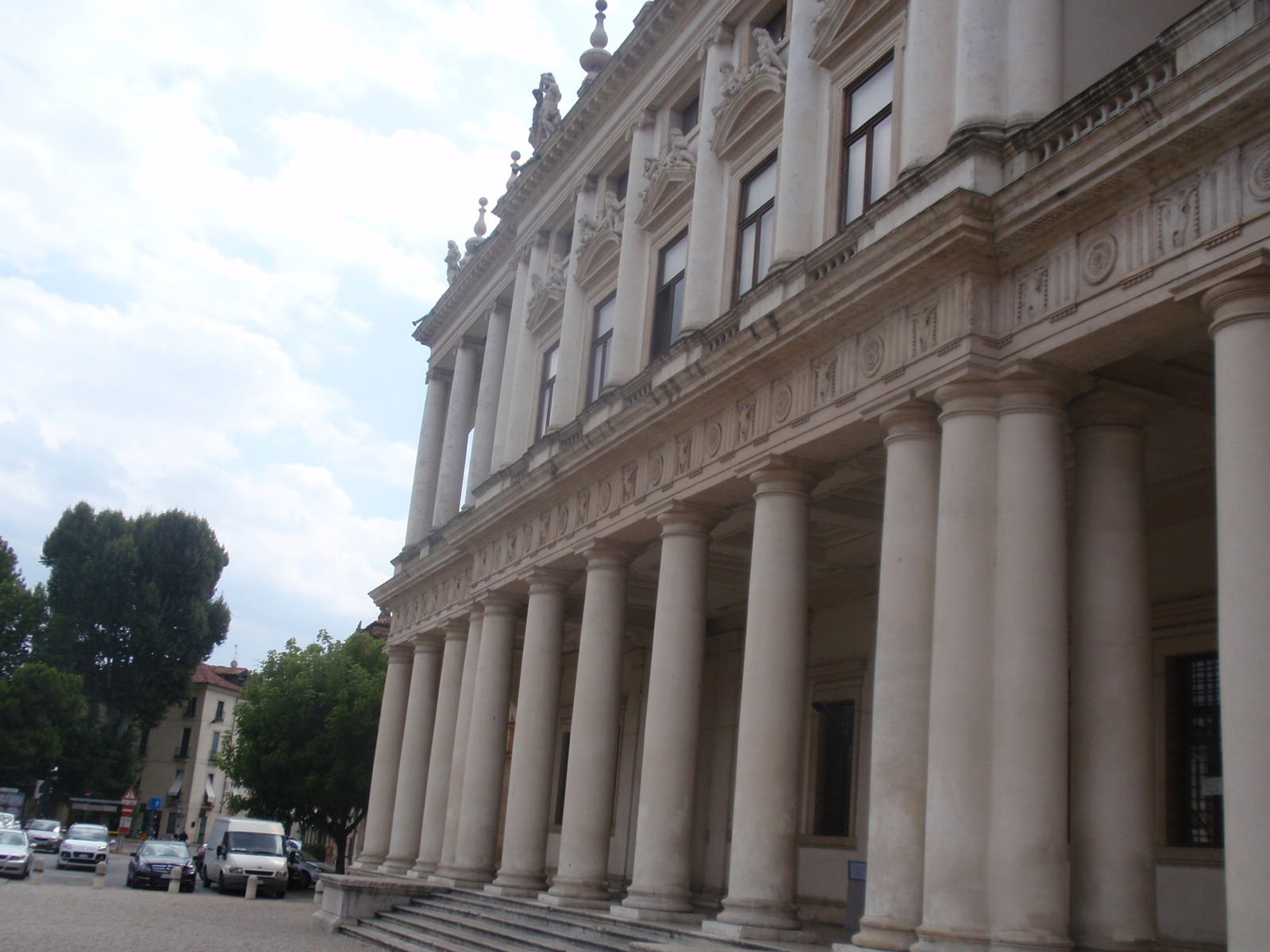
                Some of Palladio's buildings in Vicenza

                Alcuni palazzi Palladiani a Vicenza


Cenni storici - Parte I
Vicenza affonda le sue origini  ad alcuni secoli prima di Cristo: la sua fondazione, infatti, è collocabile tra i secoli XI e VII a. C. quando gli Euganei vi posero le fondamenta. 
Con i romani, nel 49 a. C., la città divenne Municipium con il nome di Vicetia. In tale periodo si costruirono templi, ville e un grande teatro (il teatro Berga), del quale rimangono pochi resti architettonici nella parte meridionale del centro cittadino. Altra preziosa testimonianza dell'epoca è il criptoportico romano in piazza Duomo, parte di una Domus Patrizia. Sotto il Duomo sono conservati e visitabili i resti di antiche abitazioni e strade.
Dopo il crollo dell’Impero, l’antica Urbs venne devastata dalla furia delle orde barbariche. Rifiorì sotto il governo longobardo e divenne sede di un ducato.
La città fu Comune libero nel medioevo e dopo lotte intestine con le  città vicine, in particolare con Padova, si consegnò spontaneamente, nel 1404,  alla Repubblica di Venezia, la quale garantì alla città un lungo periodo di pace e prosperità. Infatti, Vicenza visse un periodo di grande fervore artistico e culturale nei 4 secoli di governo della Serenissima.
Il Cinquecento vicentino, in particolare, fu il momento del grandioso lavoro del Palladio. La città si arricchì allora di monumenti di inestimabile valore come la splendida Basilica Palladiana e Vicenza divenne uno dei centri più importanti dell’architettura Rinascimentale.
Dopo la morte del Palladio avvenuta nel 1580 l’architetto Vincenzo Scamozzi completò le opere rimaste incompiute, tra cui  lo splendido  Teatro Olimpico.
Dopo un secolo turbolento, caratterizzato da pestilenze  e passaggi di eserciti stranieri, il Settecento si aprì con la costruzione di nuove chiese, palazzi e splendide ville. Fu il momento di Giovan Battista Tiepolo che proprio nelle nobili dimore vicentine espresse al massimo il suo talento. Da ricordare  in particolare il ciclo di affreschi di Villa Valmarana ai Nani del 1757.

Dal 1994 Vicenza è inserita nella lista del Patrimonio Mondiale dell’Umanità. Il suo centro storico conta infatti ben ventitre monumenti riconducibili al Palladio, mentre altre tre  sue ville sono collocate all’esterno dell’antica cinta muraria.
L’opera di Andrea Palladio, basato sullo studio approfondito dell’architettura romana, influenzò in modo decisivo l’architettura del mondo occidentale in Europa e nell’America del Nord.

                          Other beautiful buildings in Vicenza
                         Altri bellissimi palazzi  siti in Vicenza 


In Italy tomato purée is the queen of preserves. I make about 40/50 kg myself because I need it throughout the year for sauces, soups and many other dishes. If you are a beginner I suggest you start with a few kilos of tomatoes. In my experience, and since I like a nice thick purée, one kg of tomatoes makes about 50/60% of purée.  July and August are the best months to buy tomatoes that must be firm, and ripe. I use “Roma” tomatoes for my purée.


La passata di pomodoro è la regina delle conserve e io ne preparo una grande quantità perché mi serve per tutto l’anno. Se siete alle prime armi vi consiglio di cominciare con pochi chili di pomodori. Secondo la mia esperienza e, siccome a me piace una passata bella densa, un kg di pomodori rende circa il 50/60% di passata. Luglio e Agosto sono i mesi migliori per acquistare i pomodori che devono essere sodi, rossi e maturi. Io utilizzo i pomodori “Roma” per la mia passata.


Making tomato purée:


Thoroughly wash the tomatoes, removing any dented or rotten ones. Put the tomatoes into the tomato press, a tool that separates pulp from skin and seeds. Collect the pulp in a wide stainless steel pot with high sides (the wider the pot the quicker water evaporates). Put the pot over a moderate heat and stir occasionally to prevent it from sticking to the bottom. To get the right consistency the purée must boil over moderate heat for about 2/2 ½ hours. Meanwhile, sterilize the jars and lids, replacing the damaged lids with new ones. When the purée is ready put it into the jars  (use an oven mitt to handle the vase because the purée is boiling hot), close the jar well and place it upside down and under a blanket until completely cooled (about 24 hours). In this way the vacuum is strong enough to seal the jar and pull in the lid, causing the popping sound as the jars cool. When you hear the pop, the jar is vacuum sealed. When the jars are cooled put them upright and check the lids for tight seals by making sure they don’t flex up or down when the lid centres are pressed. If the lids have not sealed the purée must be refrigerated or reprocessed.   To me, this has happened only once when I first adopted this procedure (about 8 years ago) and only for 2 or 3 jars. The secret is to screw the lid on properly and tightly and I assure you that you won’t have any problems. As I have already said,  I usually make about 40 to 50 kg of tomato purée so I know that this method works. The purée may be kept for a year in a cool and light protected place.
To open the vacuum sealed jar you have to give a sharp blow with the palm of your hand on the bottom of the jar.


Passata di pomodoro :

Lavate accuratamente i pomodori, eliminando eventualmente quelli marci o ammaccati. Passateli nel spremipomodoro, un utensile che spreme il pomodoro, eliminando i semi e le bucce. Mettete  la polpa di pomodoro in una pentola d’acciaio inox alta e larga per facilitare l’evaporazione. Mettete sul fuoco e mescolate  di tanto in tanto per evitare che si attacchi al fondo della pentola. Per avere la giusta consistenza la passata deve bollire, a fuoco moderato, per circa 2/ 2 ½ ore. Nel frattempo sterilizzate i barattoli e i coperchi, eliminando quelli rovinati. Quando la passata è pronta invasatela caldissima (usate un guanto da forno per maneggiare il vaso), chiudete bene il barattolo e collocatelo capovolto e sotto una coperta fino al completo raffreddamento (circa 24 ore dopo). Una volta che i barattoli sono freddi rimetteteli in posizione e schiacciate il tappo al centro: se fa “click”, non si è formato il sottovuoto, quindi conviene mettere i barattoli in frigo e mangiare la passata in tempi brevi. A me questo è successo soltanto la prima volta che ho adottato questa procedura e solo per 2 o 3 barattoli. Il segreto è di avvitare bene il tappo e vi assicuro che non avrete problemi. Di solito io preparo dai 40  ai 50  kg di passata e quindi se il sistema non funzionasse lo abbandonerei subito. La passata, se il sottovuoto è avvenuto correttamente, può essere conservata anche per un anno in un luogo fresco e al riparo dalla luce.
Per aprire il barattolo sottovuoto dovete dare un colpo secco con il  palmo della mano sul fondo del barattolo.

2012/07/11

My garden


Mine is a small south-facing garden and in the northern hemisphere that means full sun.  We live in the Pianura Padana (Po River Valley) which in summer is very hot and humid.  So far, this summer has been brutal, so incredibly hot with oppressively high humidity. Farmers are complaining that their crops are suffering because of the little rain. I suppose that the prices of fruit and vegetables are going to rise, just like the heat. For one reason or another prices rise quite frequently lately.
Our  garden is looked after by my hubby who is quite proud of his work. Unfortunately, he cannot irrigate it often now as there are water restrictions.  The photos that you see in this post have been taken in May when the days were cooler and the garden looked a lot better.

Il mio è un piccolo giardino esposto a sud e questo significa pieno sole! La zona dove vivo, la pianura padana,  è molto calda ed umida in estate. Finora, quest'estate è stata brutale, così incredibilmente calda e con un alto tasso di umidità. Gli agricoltori si lamentano che le colture stanno soffrendo a causa della poca pioggia. Suppongo che ora i prezzi di frutta e verdura saliranno, proprio come le temperature. Per un motivo o un altro negli ultimi tempi i prezzi tendono a salire molto frequentemente. Il nostro giardino è curato da mio marito che è molto orgoglioso del suo lavoro. Purtroppo ora vi sono delle restrizioni sull'uso dell'acqua è quindi il giardino ne sta soffrendo.  Le foto che vedete in questo post sono state scattate in maggio quando i giorni erano più freschi e il giardino  bello e verdeggiante!


                  Geraniums  and sweet-scented surfinias
                        Gerani e le profumate surfinie


Small rocky garden corners
Piccoli angoli di giardino roccioso


The vegetable garden
L'orto


  Tomatoes ripening
Pomodori 


Italians love eating good food and so does my family; good light food, made with fresh seasonal ingredients, small portions, limited amounts of fat, lots of fruit and vegetables. A weekday meal is a simple affair, especially in summer. Cooking on hot sticky days is a burden but since I'm an early bird I manage to prepare the dishes in the coolest hours of the day. I like to experiment new recipes and I try to vary my home menu often. It is definitely easy to dedicate time to cooking when you have and interest in cooking. 

Tomatoes are plentiful in my garden in this period and I manage to pick about 2 kilos every day. They're the most popular vegetable in Italy and are delicious raw, fried, baked and stuffed. Irreplaceable in sauces and condiments; in short, you can consume them in a thousand ways. Today I have decided to prepare a baked pasta that we'll eat cold, after 3/4 hours. 

Baked pasta for 4 people
1 kilo of plum tomatoes
Olive oil, oregano, thyme and basil
Salt, pepper , lemon zest and bread crumbs
Grana Padano or Pecorino cheese
300 g short pasta

Halve the tomatoes, remove their seeds, season with salt, oil, thyme and basil. Sprinkle with parmesan cheese and crunchy breadcrumbs. Bake at 200 ° (400° F) for 30 minutes. Meanwhile cook the pasta "al dente" (literally "to the tooth" - when the pasta is cooked al dente there's a slight resistance in the centre when it is chewed), pour out the pasta and rinse with cold water so as to stop the cooking process. Put in a capable oven dish and season the pasta with plenty of oil, basil, lemon zest, thyme, parmesan and pepper. Once the tomatoes are baked  peel and chop them coarsely and add to the pasta. Again add some grated cheese and sprinkle with more breadcrumbs. Taste and add salt or cheese if necessary. Bake for another 20 minutes. Let cool out of the oven and serve  after a few hours. If you want, you can also add anchovy fillets and diced mozzarella before putting into the oven.


Gli italiani amano il buon cibo e la mia famiglia non fa eccezione! Mi piace preparare cibi semplici e leggeri utilizzando prodotti freschi e di stagione. Cucinare in queste giornate torride non è uno scherzo ma,  siccome sono mattiniera, preparo i piatti nelle ore più fresche della giornata. Mi piace sperimentare nuove ricette e cerco di variare il mio menu  spesso. E' decisamente più facile dedicare tempo alla cucina quando si ha un interesse per la cucina.

La raccolta dei pomodori del mio orto è abbondante in questo periodo; ogni giorno nei raccolgo circa 2 kg e li preparo in vari modi. Il pomodoro è l'ortaggio più diffuso in Italia ed è squisito crudo, insostituibile in salse e condimenti, ma è ottimo anche fritto, al forno, imbottito o gratinato. Insomma, lo si può consumare in mille modi. Oggi ho deciso di preparare  una pasta al forno, sempre apprezzata da tutti e che mangeremo fredda, dopo circa 3/4 ore. 

Pasta al forno per 4 persone
1 Kg di pomodori perini
Olio d'oliva, origano, timo e basilico
Sale, pepe, buccia di limone grattugiata e pane grattugiato
Grana padano o pecorino
300 gr di pasta corta

Tagliare a metà i pomodori, togliere loro i semi, condire con sale, olio, timo e  abbondante basilico. Spolverizzare con formaggio grana e pane grattugiato. Infornare a 200° per 30 minuti. Nel frattempo cuocere la pasta al dente, scollare e passare nell'acqua fredda per fermare il processo di cottura. Condire la pasta con abbondante olio, basilico, buccia di limone grattugiata, timo, grana e pepe. Una volta cotti i pomodori al forno togliere loro la pellicina,  tagliuzzare grossolanamente  e unire alla pasta. Aggiungere ancora del formaggio grattugiato  e spolverizzare con dell'altro pane grattugiato. Assaggiare ed eventualmente aggiustare di sale e formaggio. Infornare per altri 20 minuti, sempre forno a 200°. Lasciare raffreddare fuori dal forno e servire dopo alcune ore.  Se volete, prima di infornare la pasta,  potete aggiungere anche dei filetti di alici e dei dadini di mozzarella. 


                       Bake the tomatoes for 30 minutes
                       Gratinare al forno per 30 minuti


                         Another 20 minutes in the oven 
                         Ancora 20 minuti nel forno