2013/07/17

Vicenza in bloom


Light pink purslane on my window sill


Hello everyone! Due to family commitments, in recent times I haven’t updated my blog as I would  have liked. Anyway, after a timid beginning, summer has definitely arrived with a bang! The days are long and hot with temperatures soaring over 30° C. Mother Nature is at its best in this sunny season and its gorgeous flowers provide us with an unending spectrum of colours as well as amazing scents.  Flowers and plants add colour, fragrance and personality to our homes  and even  a tiny balcony can be transformed into a small piece of heaven full of charm and magic. Yesterday, as I strolled through the old city centre  of Vicenza I shot the following photos.


Ciao a tutti! A causa di impegni familiari, in questi ultimi tempi non ho aggiornato il mio blog, come avrei voluto. Comunque, dopo un timido inizio, l’estate è decisamente arrivata: le giornate sono lunghe, calde e, ahimé, anche piuttosto umide.  In questa soleggiata stagione Madre Nature è al suo meglio  ed i suoi splendidi fiori ci forniscono una gamma infinita di colori e profumi meravigliosi. Fiori e piante aggiungono colore, fragranza e personalità alle nostre case e anche un piccolo balcone può essere trasformato in un piccolo angolo di paradiso ricco di fascino e di magia. Ieri, passeggiando nel centro storico di Vicenza, ho scattato le seguenti foto.


Flower market


Flower shop


Flower pot in front of a "gelateria"


Red and white flowered terrace (the colours of Vicenza)


Gran  Caffè  Garibaldi  


Flowered balconies


Talking about flowers, the members of my family all love fried zucchini flowers and so, as long as they’re in season, I prepare them often.

Ingredients for 4/6 people
30 zucchini flowers
150 g flour
200 ml of milk
2 eggs
Salt

Prepare the batter with eggs, a pinch of salt, flour and milk and mix until smooth.  Let the batter rest in the refrigerator for at least an hour. In the meantime, prepare  the flowers, removing the stem, the pistil and the thorny parts attached to the flower. Rinse the flowers and pat dry with kitchen paper. Heat a little olive oil or peanut oil in a non-stick pan. When the oil is hot, take the batter from the fridge. Cold batter is the key for crisp coating. Dip a few flowers at a time into the batter and cook until they are golden, turning during cooking. Let dry on a paper towel and salt according to your taste.


The zucchini plant 


A proposito di fiori, a casa mia sono molto apprezzati i fiori di zucca fritti e quindi, finché ci sono, li preparo frequentemente.

Ingredienti per 4/6 persone

30 fiori di zucca
150 g farina
200 ml di latte
2 uova
Sale

Preparate la pastella con le uova, un pizzico di sale, la farina e il latte. Mescolate fino ad ottenere un impasto omogeneo.  Lasciate riposare l’impasto in frigorifero per almeno un’ora. Nel frattempo pulite i fiori, eliminando il gambo, il pistillo e le parti spinose attaccate al fiore. Sciacquate i fiori ed asciugateli con della carta da cucina. Scaldate un po’ di olio d’oliva o di arachidi, in un tegame antiaderente. Quando l’olio è ben caldo, riprendete la pastella dal frigorifero. Più fredda è la pastella, più croccante sarà la frittura. Immergete pochi fiori per volta nella pastella e cuoceteli finché saranno dorati, girandoli durante la cottura. Fate asciugare su della carta da cucina e salate secondo il vostro gusto. I fiori di zucca fatti in questo modo sono deliziosi sia caldi che tiepidi. 


Zucchini flowers


Batter for frying zucchini flowers 


Fry a few flowers at a time  


Crisp and golden zucchini flowers

2013/06/11

Sweet "Sandra"


Upper Castle


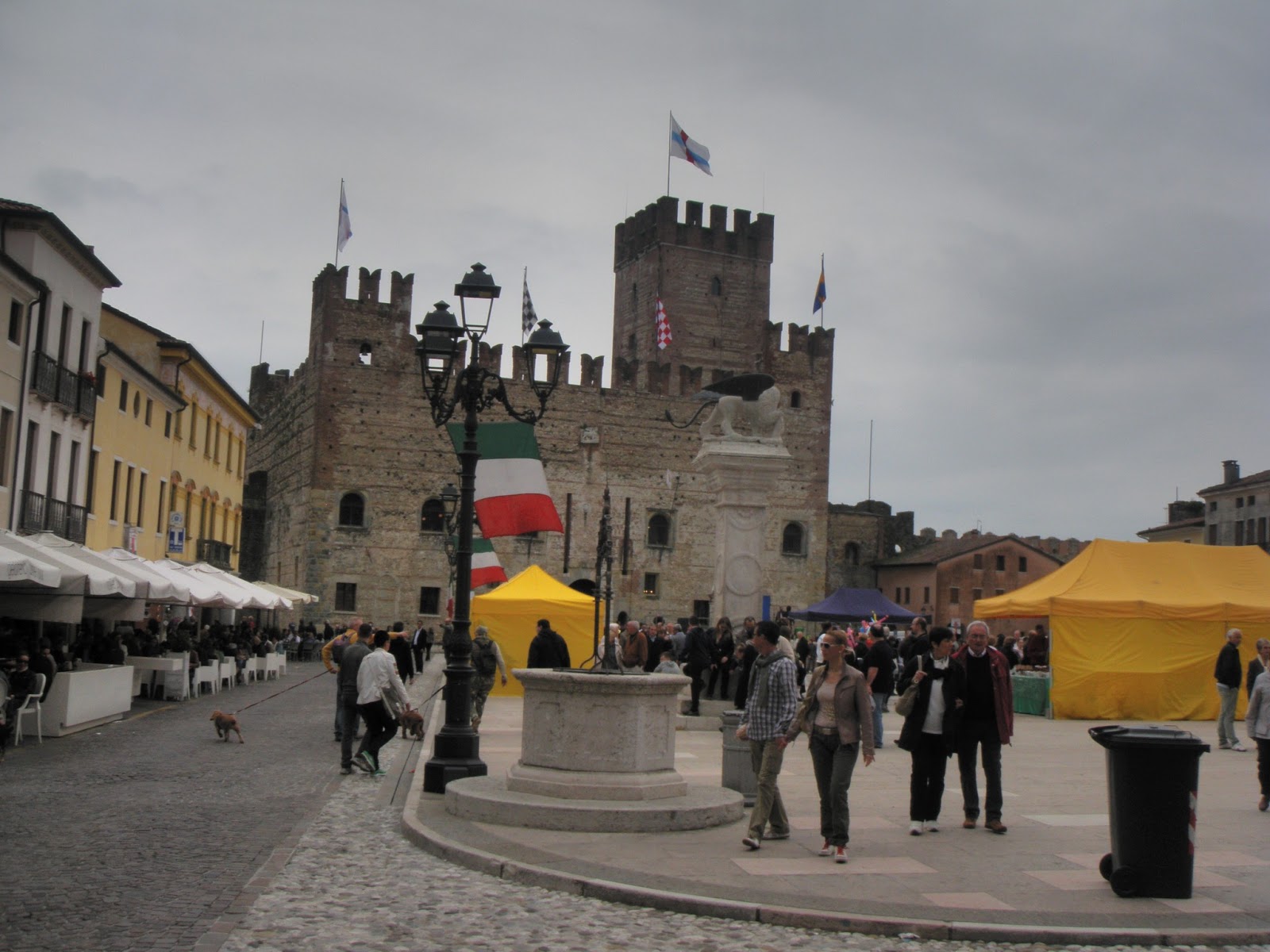
Marostica is a small, well preserved, medieval town about 30 km north of Vicenza. The city is entirely enclosed within majestic Scaliger walls that connect the Upper Castle on the Pausolino Hill to the Lower Castle overlooking  Marostica’s main square, Piazza Castello. It is in this choreographic and suggestive square, paved like a chessboard, that in September of every even year, a fascinating living chess game takes place.  
The tradition goes back to 1454 when two noble knights, Rinaldo d’Angarano and Vieri da Vallonara both fall in love with the beautiful Lionora, daughter of the Lord of Marostica: Taddeo Parisio. Instead of fighting, Parisio established that the duel would be resolved with a chess game and that the winner would have Lionora’s hand.
The historical representation involves more than 500 costumed human chess-pieces: knights, chevaliers, archers, dames, pageboys, bishops and many more, who parade to renew the challenge. The show lasts about two hours and every move on the chessboard is announced by a herald. The next living chess game will take place in September 2014.  

Marostica is quite small and the main features are the two castles and the main square. The Lower Castle houses a permanent exhibition of the traditional costumes used during the chess game  and is worth a visit. A road leads up to the Upper Castle but if you prefer walking, a footpath zigzags its way up through the lovely green hillside; one hour and a half will be enough to walk up to the hilltop, admire the magnificent views of the town below and descend again. The Upper Castle hosts a very characteristic restaurant with a beautiful terrace, but you will find many other small restaurants that serve fantastic food in the streets near the main square.  I suggest a walk through the back streets of this charming and elegant town and if you have time just sit down and relax in one of the many cafés or gelaterie. 


Lower Castle


Human Chess Game in Marostica (photo from the web)

Marostica è un piccolo, ben conservato, borgo medievale a circa 30 km a nord di Vicenza. La città è interamente racchiusa all'interno di imponenti mura scaligere che collegano il Castello Superiore, sul Colle Pausolino, al Castello Inferiore affacciato sulla piazza principale di Marostica, Piazza Castello. E 'in questa coreografica e suggestiva piazza, pavimentata a scacchiera, che nel mese di settembre di ogni anno pari, si svolge l’affascinante  “Partita a Scacchi” con personaggi viventi.
La tradizione risale al 1454 quando due nobili cavalieri, Rinaldo d'Angarano e Vieri da Vallonara s’innamorano entrambi della bella Lionora, figlia del Signore di Marostica: Taddeo Parisio.  Invece di un combattimento, il Parisio stabilì che il duello si sarebbe risolto con una partita a scacchi e che il vincitore avrebbe avuto la mano di Lionora.
La rappresentazione storica coinvolge più di 500 personaggi in costume d’epoca: cavalieri, arcieri, dame, paggi,  musici e molti altri che sfilano per rinnovare la sfida. Lo spettacolo dura circa due ore e ogni mossa sulla scacchiera è annunciata da un araldo. La prossima partita si svolgerà nel mese di settembre 2014.
Marostica è piuttosto piccola e le caratteristiche principali sono i due castelli e Piazza Castello. Nel Castello Inferiore la mostra permanente dei costumi utilizzati durante la partita a scacchi, merita una visita. Una strada conduce al Castello Superiore, ma se preferite camminare, potete avventurarvi sul bel sentiero che si snoda attraverso la verdeggiante collina; un'ora e mezza sarà sufficiente per camminare fino alla cima della collina, ammirare la magnifica vista della città sottostante e ridiscendere. Il Castello Superiore ospita un ristorante molto caratteristico con una bella terrazza, ma troverete molti altri piccoli ristoranti che servono dell’ottimo cibo nelle strade vicine alla piazza principale. 


Terrace in bloom and  cute café in Marostica


Marostica is also known as “the city of cherries” and hosts a cherry festival between the end of May and the beginning of June. In 2002, the cherries of this territory, considered among the best in Italy, obtained the IGP classification (Protected Geographical Indication). The acronym indicates an authentic and high quality  product originating from a specific region  which is a guarantee for consumers and also a safeguard for producers with respect to possible imitations and unfair competition.  The Marostica IGP cherries are produced in just a small area around Marostica, the use of pesticides has been significantly reduced and the harvest is done completely by hand.  


Juicy ripe cherries

The variety “Sandra” is native to the territory and is named after Alessandro Bertolli who discovered this juicy and flavourful cherry in 1926. During the cherry blossom season, when the landscape is at the top of its beauty, a walk along the “road of cherries” is a must for all nature lovers. Unfortunately, because of the cold and rainy weather, this year’s harvest is meagre and late.


Cherry exhibition in Marostica

Conosciuta anche come la città delle ciliegie, Marostica ospita una mostra delle ciliegie tra la fine di maggio e l'inizio di giugno. Nel 2002, le ciliegie di questo territorio, considerate tra i migliori in Italia, hanno ottenuto la classificazione IGP (Indicazione Geografica Protetta). La sigla indica un prodotto di  alta qualità proveniente da una regione specifica ed è una garanzia per i consumatori e anche una salvaguardia per i produttori rispetto a possibili imitazioni e concorrenza sleale. Le ciliegie IGP di Marostica sono prodotte soltanto in una piccola area attorno a Marostica, l’utilizzo di pesticidi è stato fortemente ridotto e la loro raccolta è completamente fatta a mano.


Dark red cherries

La varietà "Sandra" è autoctona del territorio e prende il nome da Alessandro Bertolli che scoprì questa succosa e saporita ciliegia nel 1926. Durante la stagione di fioritura dei ciliegi, quando il paesaggio è al suo massimo splendore, una passeggiata lungo la "strada delle ciliegie" è un piacere per tutti gli amanti della natura. Purtroppo, a causa del freddo e delle piogge, la raccolta delle ciliegie quest’anno è scarsa e in forte ritardo. 


If you have some fresh cherries here is a simple recipe to make a wonderful dessert.

Cherry clafoutis

500 g of ripe cherries
150 g flour
150 g sugar
3 eggs
½ litre milk
butter
Salt

In a bowl, mix sugar and eggs; incorporate into the mixture the flour, a pinch of salt and, little by little, the milk, stirring well until you have a perfectly smooth batter. Let stand at least 1 hour. If you want a clafoutis slightly richer in texture and taste you can use a mixture of cream and milk, instead of just milk. 


Preheat the oven to 200° C. Wash the cherries, remove the stems and pit them. Grease a baking dish thoroughly with some butter. Spread the cherries on the bottom of the pan, pour the batter, without moving the cherries, and put in the oven for 45 minutes. The clafoutis is best served warm with a dusting of powdered icing sugar. 


Cherry clafoutis

Se disponete di ciliegie fresche, ecco una ricetta semplice per fare un dessert meraviglioso.

Clafoutis alle ciliegie

500 g di ciliegie mature
150 g farina
150 g zucchero
3 uova
½ litro latte
Burro
Sale

In una terrina mescolate lo zucchero e le uova; incorporate al composto la farina setacciata, un pizzico di sale e, poco per volta, il latte, mescolando bene finché avrete una pastella perfettamente liscia. Lasciatela riposare almeno 1 ora. Se volete un clafoutis leggermente più ricco di sapore, al posto del solo latte, potete utilizzare una parte anche di panna.
Accendete il forno a 200°. Lavate le ciliegie, privatele dei piccioli e snocciolatele. Imburrate abbondantemente una pirofila. Distribuite le ciliegie sul fondo della pirofila, versatevi la pastella senza spostare le ciliegie; mettere in forno per 45 minuti.  Servite il clafoutis tiepido, o freddo. 


Slice of cherry clafoutis

2013/05/25

Something yellow


Bunch of yellow tulips


In the Christian world yellow is synonymous with Easter, which in the northern hemisphere falls in the spring, a time of rebirth. I also associate yellow with spring because of the warmth, the light and the energy it transmits. So far this springtime has been very unstable, mostly rainy days and cold weather, but I'm sure that before long the sun will warm us with its golden rays. Yellow is also the colour of many spring flowers: dogwood and primroses are the first to bloom in the woods, dandelions colour the meadows and daffodils and buttercups flutter and dance amongst the tall grass.


Yellow and orange gerberas growing in my garden


Yellow and white primroses


Other yellow flowers 


Nel mondo cristiano il giallo è sinonimo di Pasqua, che nell'emisfero settentrionale cade in primavera, un periodo di rinascita. Anch’io, quando penso alla primavera, penso al colore giallo per il calore, la luce e l’energia che mi trasmette. Finora la primavera è stata prevalentemente instabile, a tratti fin troppo piovosa e capricciosa, ma sono sicura che tra non molto il sole tornerà a riscaldarci con i suoi raggi dorati. In primavera molti sono i fiori gialli: le primule e il fiore del corniolo sono i primi a sbocciare nel bosco,  il tarassaco colora di giallo i prati ed il ranuncolo ed il botton d’oro danzano tra l’erba alta dei campi. 


More garden flowers: yellow roses


Yellow makes me also think of the warm sun of southern Italy, especially of the enchanting Amalfi Coast and the typical terraced orchards where lemons grow abundantly. The famous lemon liqueur “Limoncello” comes from this part of Italy.


Organic lemons 


Il giallo mi fa venire in mente il caldo sole del Sud d’Italia, in special modo all’incantevole Costiera Amalfitana e le tipiche terrazze coltivate ad agrumeti. Il microclima della zona favorisce la crescita di un limone particolarmente profumato che viene impiegato nella preparazione del famoso liquore "limoncello". 


Lemon zest and alcohol


10 organic lemons
1 litre tasteless clear alcohol 90/95 °
700 g refined white granulated sugar
1,25 litres of water
Wash the lemons very well using a  brush because it’s actually the skin you'll use to make Limoncello, dry them and, with a vegetable peeler, remove the lemon zest without the white pith. Put the alcohol and the zest in a large glass bowl covered with plastic film and let rest in a dark, cool place for at least 10 days. Prepare the syrup with 1,25 water and 700 g sugar and bring to a boil, stirring till the sugar is completely dissolved. When the syrup has cooled add it to the limoncello mixture, discarding the lemon zest. Pour into glass bottles and let the limoncello stand for about a week before tasting. Limoncello is great after a good dinner served well chilled. 


Discard the zest from the Limoncello

10 limoni non trattati
1 litro alcool 90/95°
700 g zucchero semolato
1,25 litri d’acqua

Lavate molto bene i limoni, asciugateli e con il pelapatate togliete loro soltanto la parte gialla della buccia.  Lasciate macerare, in un recipiente di vetro coperto con la pellicola, le bucce con l’alcool per almeno 10 giorni, in un ambiente fresco e buio. 
Trascorso questo tempo, preparate lo sciroppo di zucchero: versate 700 g di zucchero e 1,25 litri d’acqua in una pentola che scalderete a fuoco medio, mescolando fino al completo scioglimento dello zucchero. Quando lo sciroppo si è raffreddato aggiungetelo alla macerata, filtrate le bucce e imbottigliate in bottiglie di vetro. Il limoncello è ottimo a fine pasto servito in bicchierini di vetro precedentemente fatti raffreddare nel freezer. 

Limoncello 

2013/05/23

Waiting for "Il Giro d'Italia"


Children's pink jersey drawings decorating a shop window


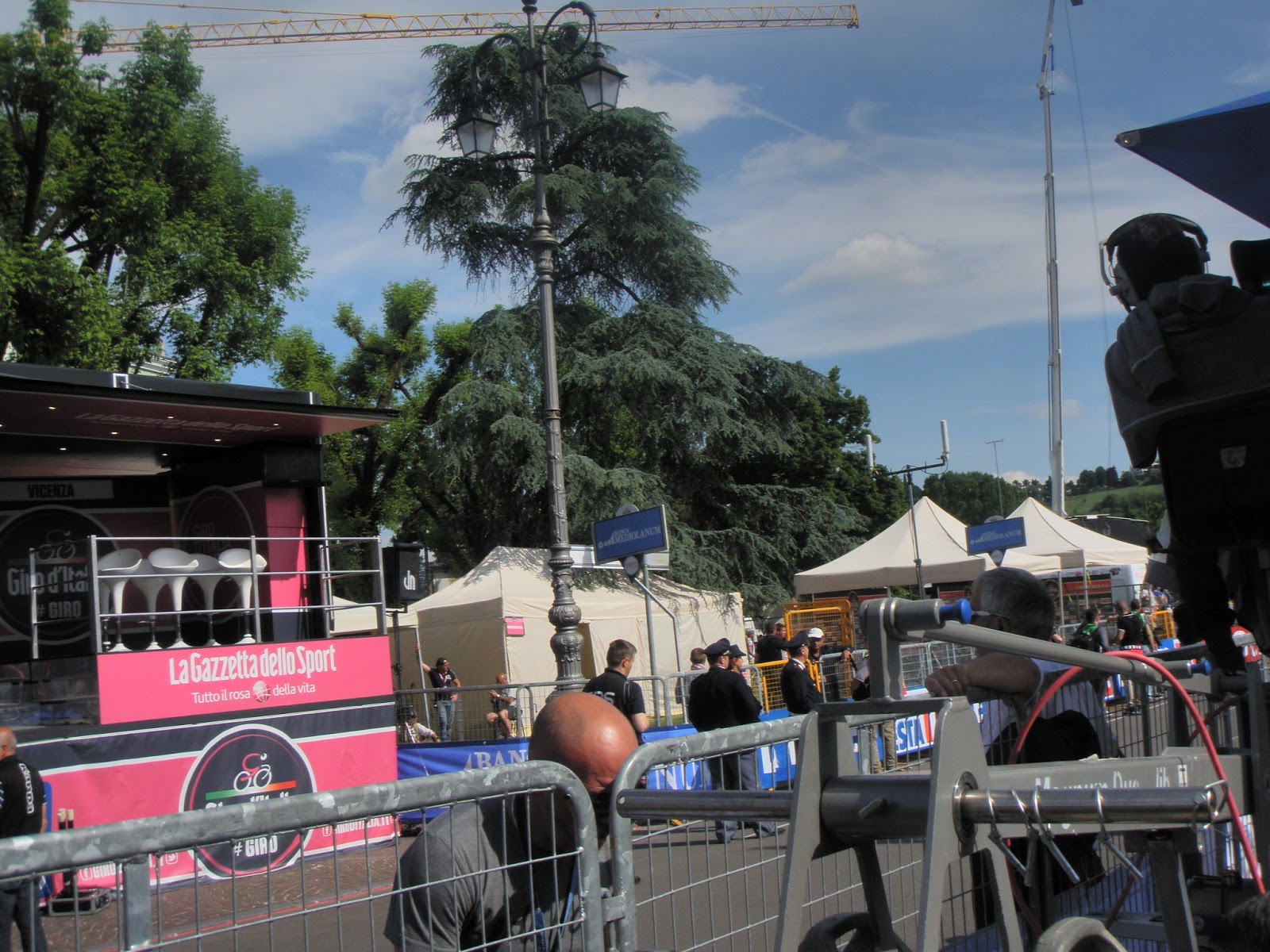
Yesterday I decided to go to Viale Roma to see the arrival of the “Giro d’Italia”. Once there, I quickly realized that it was going to be hard to see the finish, so I positioned close to a large screen to follow the progress of the race. There was a lot of people and the atmosphere was really festive. When the “pink caravan” - a parade of sponsor vehicles - arrived, it seemed carnival time!   


The large screen showing the race

Avendo qualche ora a disposizione ieri ho deciso di recarmi in Viale Roma per assistere all’arrivo del Giro d’Italia. Appena arrivata ho capito subito che non avrei visto nulla e quindi mi sono posizionata vicino ad un maxi schermo per seguire l’andamento della corsa. C’era una marea di gente e l’atmosfera era veramente festosa; con l’arrivo della “carovana” del Giro, che precede i corridori di una buona ora,  sembrava di essere a carnevale: un tripudio di colori e musica!


Waiting for the race finish 


Young riders waiting to see "Il Giro"


The "Pink Caravan"


It 's really impressive how many people work for the success of each stage.


Cameramen


E’ veramente impressionante quanta gente lavora per la buona riuscita di ogni singola tappa. 


Sales


Security


And the winner is.......Giovanni Visconti!